


Latest knowledge products


Published: 3 March 2026
A Conversation with the 2025 Inclusive Research Award Winner
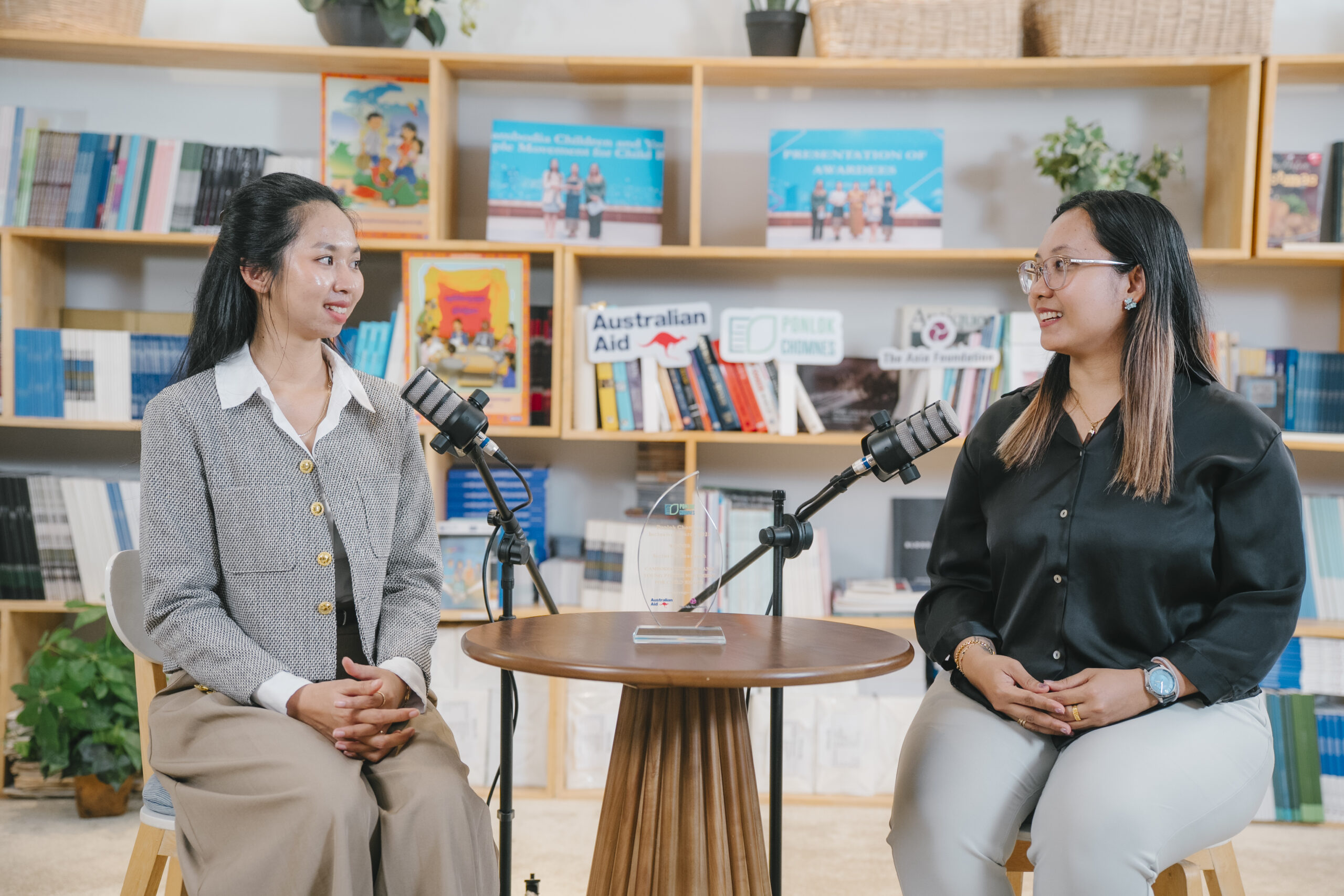
Ms. Neak Sokunthea (left) and Ms. Eng Chandy (right)
Below is a transcript of a conversation between Ms. Eng Chandy, the Executive Director of Gender and Development for Cambodia, and Ms. Neak Sokunthea, Team Lead of the Executive Team of the Cambodian Children and Youth Movement for Child Rights and recipient of the 2025 Inclusive Research Award.
- Chandy: Chumreap Sour (Hello) and welcome to Episode 3 of the Podcast4Inclusion. This week, we are meeting with the winner of the Inclusive Awards 2025. We are joined by Ms. Neak Sokunthea from the Cambodian Children and Youth Movement for Child Rights (CCYMCR), who is the winner of the Inclusive Research Award. This award is presented to those who produce research that goes beyond just a title and extends inclusive learning through the study itself and its findings. Kunthea reminded us that research is vital when we amplify the voices of children, allowing those voices to make an institution, a research organisation, or the research outcomes inclusive. Chumreap Sour, Kunthea.
- Sokunthea: Chumreap Sour.
- Chandy: Welcome to Episode 3. Kunthea, could you please introduce yourself as well as CCYMCR, so our audience can get to know you better?
- Sokunthea: Chumreap Sour and hello to all our viewers. I am Neak Sokunthea, the Executive Director of the Cambodian Children and Youth Movement for Child Rights, abbreviated as “CCYMCR”. CCYMCR is a non-governmental association working as a network led by children and youth. We operate independently, neutrally, and as a non-profit to serve the best interests of the child without discrimination. Our vision is to ensure that all children in Cambodia receive full rights as stated in the United Nations Convention on the Rights of the Child (UNCRC). We play a key role in promoting child rights by urging duty bearers—whom we identify as the Royal Government—to implement the Convention, with the direct participation of rights holders, who are the children and youth.
- Chandy: Thank you, Kunthea. I know that you established CCYMCR with your team. In which year did you start, continuing up to the present?
- Sokunthea: Yes, we established CCYMCR in 2002 as a child and youth network group, and we officially registered as a non-governmental association in 2009.
- Chandy: Looking at the age of the organisation, it has been over 10 years, so there must have been a lot of work. Getting back to the topic of our award- did you know that you had been nominated as a candidate for the Inclusive Award 2025?
- Sokunthea: Yes, I knew because Mr. Hong Reaksmey, the Country Director of Save the Children Cambodia, sent me the information regarding the competition and said he wanted to nominate CCYMCR. After that, I reviewed the competition details and became interested in the Inclusive Research Award because we had just recently finished a research project in October 2025—oh, apologies, in 2024. We saw that our research work seemed to align with the competition’s criteria, so we decided to submit it for the competition. We first submitted it around the end of January 2025. After that, we saw the programme was delayed until June, so it was quite a long time. We waited for a while without seeing any results announced. Then, in July, I saw an invitation email to attend a National Policy Forum, and I confirmed immediately because I wanted to know. I saw the agenda included a winner announcement, but there was no announcement on social media about who had won. So, I continued waiting until mid-July when the team emailed asking for additional information. I was quite busy at that time with training, but I tried to find the additional documents regarding the consent forms, clearing replies on child safeguarding and child labour issues. They asked me to send it back before 5:00 PM, but I sent it a bit late. I felt that if I was going to fail, I would fail right then because I sent it late. I waited longer and still saw no news, so I checked with Reaksmey. He asked the Ponlok Chomnes team, but they said they wouldn’t tell; the committee wanted to keep it a surprise. So, I just waited to attend the event to hear the results.
- Chandy: Right, thank you very much. It really was quite a journey to win this Inclusive Research Award. I imagine the audience is eager to know what CCYMCR’s research actually focuses on and what form it takes. So, I shall hand the floor over to you, Kunthea. Could you please explain to our audience a bit about the nature of this research and its key focus?
- Sokunthea: Yes, certainly. Our research is titled “Participatory Child Rights Situation Analysis.” We worked with our target groups, consisting of children and youth across 22 communes- specifically the clubs located within those 22 communes- spanning 13 provinces. The total number of child respondents who provided information was approximately 459. This included boys, girls, children with disabilities, children with diverse gender identities, and indigenous minority children. In conducting this study, we had two main objectives. First, to identify the current challenges and problems that children are facing. Second, to listen to their recommendations regarding what they want the people around them and the Royal Government to do to fulfil their needs. We then take all these results and present them to decision-makers so that they are heard. Furthermore, this research was directly led by the children and youth themselves. So, we address children’s issues, but the researchers are the children and youth themselves.
- Chandy: Thank you. Since the title mentions “Participatory Child Rights Situation Analysis,” our listeners can likely guess a bit about the research methodology. However, to go into greater detail, could you elaborate on the specific methods used? From data collection and analysis through to the release of the final results, what was the process?
- Sokunthea: Yes. Regarding the methods or tools used in this research, it might sound a bit unique to the audience as it differs from what other institutions have done. In our research, we followed seven steps. Step 1 was training the child and youth researchers so they understood the participatory or action research methodology. They defined their research plan—when they would go to the field and what support they needed, such as budget, materials, or technical assistance. After planning, we saw them going down to collect information directly from children in their own communities.
- Sokunthea: Once collected, the research involved compiling all the issues into a draft report. But the draft wasn’t the end. To ensure the issues or information gathered were factual, it required consultation to validate the findings with the respondent children and youth again, as well as with local authorities, to see if they acknowledged that these problems truly exist. After consulting with them, the final consolidated report was prepared. The final step was the dissemination of the report to the various stakeholders identified by the children in their research. Notably, besides these seven steps, we also utilised four key tools.
- Sokunthea: The first tool is called the “Body Map,” which we use to identify the rights children enjoy and the problems they encounter. The method involves drawing, colouring, and writing on the map. In cases where children cannot write or cannot see, they can speak, and a facilitator will write it down or collect the data for them; so, we have methods for all of that. Once we have identified the issues—and naturally, there are many, perhaps 10 or 20—we cannot study them all. We need to prioritise to find the most critical issues, perhaps limiting it to a maximum of three. So, in the second stage, they use the “Rights Chart.” With this tool, the participating members can vote on which three problems they consider the highest priority. Once selected, they analyse these issues using the “Problem Analysis Tree,” which focuses on two main points: firstly, the root causes, and secondly, the effects. After analysing the tree to see where the problems come from and how they impact children, they use another tool called the “Recommendation Palm.” Here, they can note down which parties they want to address the issue- be it parents, local authorities, the Royal Government, relevant ministries, teachers, or the children themselves- listing their requests as 1, 2, 3, 4, and so on. We view the methods and tools used in this research as being “child-friendly.” When children participate in providing information, they are happy; they don’t feel it is complicated or stressful. The child and youth data collectors also feel capable of using these tools because they aren’t, as one might say, “too technical.”
- Chandy: Right. I think when we listen to what Kunthea described earlier- the seven steps of this research, along with the four methods for collecting data, analysing it, prioritising issues, and formulating recommendations- it sounds quite straightforward in just four or five minutes. However, research takes a long time, and researchers know that moving from one step to the next, and from one method to another, can present many difficulties. So, I’d like to ask: what were the challenges in this research, even though you used child-friendly methods to enable children to participate?
- Sokunthea: Yes, actually our research took quite a long time—from March until October. So, it was about six or seven months. We did face some challenges. Firstly, during the training phase, because they are children and youth, their understanding can be somewhat limited. Research is a big subject, and for some children and youth, the methods and tools were new, so they weren’t entirely clear on them. Consequently, when they went to collect information, the data they obtained wasn’t always 100% clear or acceptable to us. Secondly, regarding technical support for them—honestly, we didn’t have outside experts helping with this research. We, the staff at CCYMCR, are young people ourselves, and the participants are children and youth. So, the resources available to go down and support them were limited because our team is small, only about four or five people. Since we were working in many provinces, if they were unclear about something, we had to travel there, which required significant expenditure of resources. We also tried to have the children and youth in those specific areas conduct the research themselves as a way to save costs. If we had to send people from Phnom Penh to every single province, it would have been very expensive. So, having them do it helped us make some savings. Another challenge arose when working with children with disabilities; it was somewhat limited because, as we know, disabilities vary. Most of the children with disabilities who participated had physical impairments but could hear and speak normally, so they could join us. However, we haven’t yet been able to reach or collect information from children with severe disabilities. Nevertheless, we strove to make our research as inclusive as possible. As a solution, as I mentioned, if they lacked technical skills, we tried to go down and assist them. And if the information we received wasn’t precise, we would conduct further consultations with the groups they had worked with.
- Chandy: Thank you very much, Kunthea. The audience can see that when CCYMCR works, you rely heavily on the principles of inclusion. There is also a lot of training provided to organisation members and target groups regarding gender, disability inclusion, and social inclusion. Now, looking at the research findings, how has CCYMCR utilised these results?
- Sokunthea: Yes. After completing the research, we utilised our findings at two levels. Firstly, at the national level: initially, we disseminated our results to all stakeholders. This included relevant national ministries, local authorities at the commune, district, and provincial levels, civil society organisations, as well as children and youth. Second, the children and youth took the findings and used them to prepare a joint statement to present to decision-makers and policymakers. Examples of where they have raised these issues include the preparation of the National Action Plan on the Prevention and Response to Violence Against Children 2025–2030, International Children’s Day 2025, the Forum on Children and Policymakers, and various other national programmes. Furthermore, regarding children in the community- speaking at the sub-national level- the children’s clubs that participated in collecting the research data took those results and disseminated them to their local authorities through community awareness campaigns.
- Chandy: Yes, I heard you mention that “this research was utilised at both the national and sub-national levels.” How does CCYMCR perceive the results or the impact of this research on policymakers and stakeholders?
- Sokunthea: Yes. We have seen a number of results stemming from the issues raised, the recommendations made, and the voices of the children and youth themselves. First, we observed that the involvement of children and youth in decision-making has improved. Specifically, the Ministry included two children from our network as members of the Technical Working Group for the preparation of the National Action Plan on the Prevention of Violence. This inclusion allowed the children to participate in the entire drafting process from start to finish. They were able to monitor whether the points they raised were included. Consequently, when the plan was approved and disseminated, we saw that approximately 80% of the children’s recommendations were accepted and integrated into the plan for response. Within that 80% acceptance, one point that truly demonstrates inclusiveness is the drafters’ acceptance of the recommendation to include children with diverse gender identities. This means the plan is for all children, including those with diverse gender identities- something that was not mentioned in previous plans but is included in this one. It means that whether they are children with disabilities, children with diverse gender identities, indigenous minority children, or other vulnerable children, they are all included in the plan to address their needs. This is an achievement we are very happy about. Furthermore, following the children’s recommendations, we have seen the Royal Government’s will to accelerate the adoption of the Law on Child Protection. This is a crucial law for our children that has been awaited for many years, and we hope it will be adopted soon. Finally, regarding children in the community, the commune authorities have begun to increase the inclusion of children as members of the Committee for Women and Children (CCWC). They provide opportunities for children to participate in the Committee’s monthly meetings. This is a vital component at the sub-national level, allowing children to participate, to be informed about processes or development in their communities, and to raise issues they see or requests they have to the authorities, ensuring a timely response.
- Chandy: Thank you, Kunthea. What you have shared allows us to see that inclusive research yields results as well as numerous opportunities that enable a community to develop and allow for greater participation. For my final question, I think everyone really wants to know if they too can conduct inclusive research. They would surely like to hear some tips- although we touched upon them earlier- directly from you. What is your message for Civil Society Organisations (CSOs), researchers, or those interested in research, on how they can incorporate the principles of inclusion into their studies?
- Sokunthea: Thank you, thank you very much. For me, researchers- whether they are children, youth, or institutions conducting the study- all play an important role in bringing the voices of the vulnerable or the victimised to the attention of policymakers or decision-makers. It serves as strong evidence for decision-making. Ultimately, what we want to see is positive change for everyone, whether they are people with disabilities, people with diverse gender identities, or indigenous minorities living together in society, so that they receive equal rights. So, let us join together to ensure our research is inclusive and responsive to everyone.
- Chandy: Thank you to our audience for following episode 3 of the Podcast4Inclusion. We will meet again next week with the second winner of the Inclusive Awards. Thank you, Kunthea.
- Sokunthea: Yes, thank you.
If you would like to watch this podcast, please click here.
End.