


Latest knowledge products

28 August 2026
New Podcast Series Teaser Out Now — Take a Sneak Peek!


14 August 2026
Podcast4Inclusion EP10: Research Standards and Ethics

Published: 12 March 2026
A Conversation with 2025 Inclusive Communications Award Winner
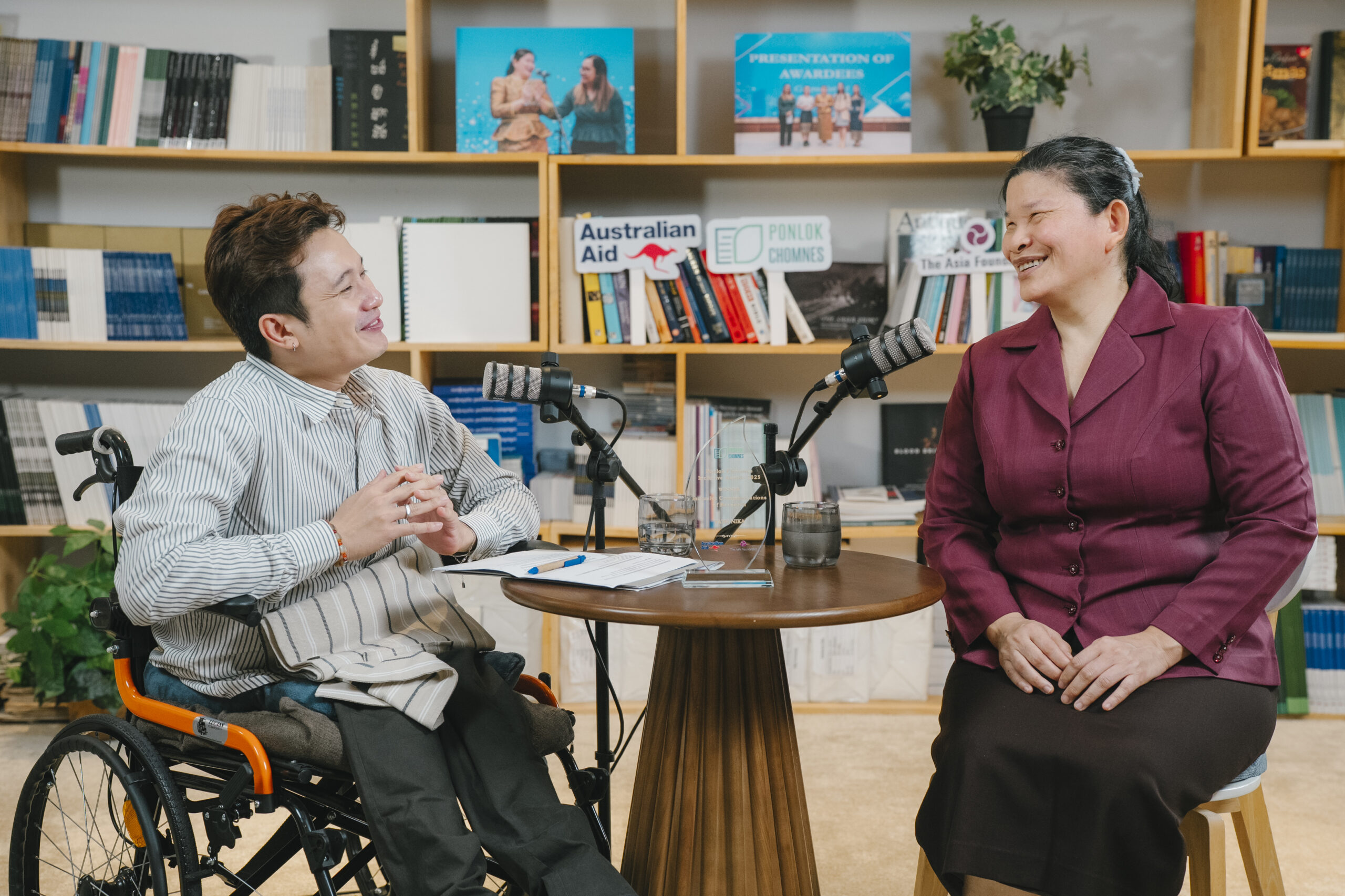
Mr. Mean Vibolratanak (left) and Ms. Tath Nika (right)
Below is a transcript of a conversation between Mr. Mean Vibolratanak, Program Coordinator of Cambodian Disabled People’s Organisation, and Ms. That Nika from the Nika’s Seeing Hands Massage Center and winner of the 2025 Inclusive Communications Award.
- Ratanak: Chumreap Sour (Hello) and welcome to Episode 4 of the Podcast4Inclusion. I am Ratanak. Today, I am truly delighted to be moderating this Podcast4Inclusion episode. Today, I will introduce our audience to another winner who received the Inclusive Awards 2025. She is Ms Tath Nika. She won the award for Inclusive Communications of Research. Furthermore, she has transformed research into a new creative form that breaks down barriers to communication. Ms Tath Nika conducted accessible research communication through storytelling, Braille, and inclusive formats. Chumreap Sour, Ms. Tath Nika.
- Nika: Chumreap Sour, Ratanak, and Chumreap Sour to all our respected and dear audience.
- Ratanak: Are you keeping well today?
- Nika: I am well! Thank you!
- Ratanak: How do you feel about participating in the podcast for the Ponlok Chomnes program?
- Nika: I feel excited and also happy to have the opportunity to share what we have with everyone.
- Ratanak: Yes, thank you very much! Our audience might be wondering who exactly Ms. Tath Nika is. So, could you please tell our audience a little bit about yourself?
- Nika: Yes, my name is Nika from the Nika Massage Dai Tep Centre in Phnom Penh. I work as a masseuse in Phnom Penh.
- Ratanak: Thank you. Since our topic relates directly to your award, I would like to know more about how you found out about the nomination for the Inclusive Awards 2025. Who informed you?
- Nika: Yes, I learned about this programme through the Women Peace Makers organisation.
- Ratanak: I see. You heard the news through Women Peace Makers. What information did they provide to you, and what made you decide to enter the competition?
- Nika: Yes. First, I wanted to know my own capabilities. Second, Women Peace Makers told me that the Ponlok Chomnes programme had an initiative specifically for people with disabilities- regardless of the type of disability-allowing us to apply for this award. So, I decided to give it a try, thinking I might have a chance. They offered to assist me; they helped write my CV because, as I am visually impaired, I could not write it myself. They facilitated that part for me.
- Ratanak: Thank you very much. So, that means you received the information for nomination from Women Peace Makers, and they also assisted you by providing information or helping to complete the requirements you needed?
- Nika: Yes!
- Ratanak: And at that moment, when you received the award and became a winner, how did you feel?
- Nika: Yes, at first, I didn’t know I had won, and I never dared to imagine that I would. When Ponlok Chomnes invited me, I thought that if I won, I would be happy, but if I didn’t, I would consider my attendance a way to congratulate the three brothers and sisters who were fortunate enough to receive the award. So, I went and sat in the meeting just like everyone else. When the announcements began, the first winner was announced, and I was excited and clapped to congratulate them. Then, for the second one, when I heard them mention the research and accessibility, I became a bit curious, but I tried not to think about it. But when I heard them announce my name, I was overwhelmed. I felt like I never thought I could… that I could ever cross such a threshold. I was extremely happy.
- Ratanak: Yes, thank you very much. Actually, what you said, Sister Nika, is absolutely true because I was also a witness at that forum. You seemed to feel it was unexpected, and at that moment, it seemed like you were both nervous and happy, mixed with tears of pride in yourself for receiving that award. Is that right?
- Nika: Yes! Yes! Basically, I never thought about it, and furthermore, I never thought I would be lucky enough to be selected by the committee.
- Ratanak: Thank you very much! So, our audience must be wondering further about what kind of story the award was for and what the story was written about. So, could you please tell me the name of the project you applied with and the meaning of that story?
- Nika: Yes, the project is named “Our Turn.” “Our Turn” means that for those of us with disabilities who feel hopeless or lack the opportunity to receive or do something we want to do for society and for ourselves, it is now our turn to act. If it is our turn and we do not act, we do not scream, or we do not raise our voices to the world or those around us, then we have no opportunity. We scream to sound out what we need. We want those around us to hear and understand our needs. We must demonstrate the capabilities we have; we must show them to the public as well as those around us.
- Ratanak: Thank you very much. So, perhaps this storyline can serve as a message for other brothers and sisters with disabilities to participate or show what they can do, in line with the story you wrote and the phrase “Our Turn.” It is an empowering phrase indicating that for those with disabilities who have capabilities, it should be an opportunity- their turn- to let the public know and understand the abilities of persons with disabilities. Since your communication took many forms, differing from other formats, what motivated or inspired you to disseminate the “Our Turn” story differently from traditional formats?
- Nika: We want the audience to understand disability, specifically our disability. So, we communicate via networks or through audio, video, and so on. We want them to understand that we, as visually impaired persons, can do things just like persons without disabilities.
- Ratanak: So, while you were producing your inclusive research findings, which included voice messages, videos, or exhibitions, did you encounter any obstacles or challenges in production regarding dissemination?
- Nika: Well, there were obstacles. For instance, first, people without disabilities cannot read Braille; only visually impaired people can. And if a visually impaired person does not have the tools, they cannot read it either. This means we had to produce something that allows everyone to know our story, both the visually impaired and those without disabilities. So, we decided to produce something with sound, like audio, for all of them so they could understand our story.
- Ratanak: Generally, since you broke down communication barriers through modern communication formats, such as video, Audio, or tactile text, which of these is the most important to you?
- Nika: For us persons with visual disabilities, the audio part is important because wherever we go, we hear. Like hearing what is broadcast on the network, audio is a vital tool for the public to know about us all, including for persons with disabilities.
- Ratanak: Yes, thank you very much. So, based on the information and experiences you have shared regarding the dissemination process, did you receive any feedback or response from persons with disabilities or the general public regarding your research findings?
- Nika: In short, it was well received. It especially reached those who follow social media. Because we produced materials in many formats, whether they have a disability or not, they could understand what we wanted to communicate and what our needs were.
- Ratanak: Have you ever received suggestions that you should continue disseminating these tactile stories, or has there been other feedback?
- Nika: Basically, we must continue to do it. Since we have the resources, we must use them to benefit both those without disabilities and those with disabilities. We want them to understand and to know about what we have, whether it is information or other things we have produced, we must disseminate it so that everyone can understand.
- Ratanak: Thank you very much. So, Sister Nika, you are someone who shares experiences and disseminates via social media; you are also a composer, a story writer, and you record audio. What message would you like to share with journalists or researchers?
- Nika: Yes. The message I want to share with those who intend to become researchers is: first, you must put your heart into it. Regardless of time or effort, if you can take what is in your heart- what you wish to do in this research- do it with full attention. In short, regardless of the time or resources you have, you must take what is in your heart and transform it into a clear objective that you must achieve. No matter the obstacles, we must persevere. Whether there are storms or whatever challenges arise before us, we must resolve them. We must turn what we have into a result for those who intend to become researchers.
- Ratanak: Thank you. Perhaps you could add a bit more to your concept. Generally, as a personal request, do you have any suggestions for the communication field as well as the research sector on how to make their research findings inclusive?
- Nika: First, we must set a goal: what is our research based on? For example, whether it concerns the disability sector or not. Once we set a goal, we must achieve that goal. If we simply see others doing something, we should not just copy them immediately. We must have our own will and determination that we must accomplish it.
- Ratanak: Thank you very much. Do you wish to see more accessibility regarding the research findings produced by researchers?
- Nika: In short, if it is possible, they should produce it in a format that allows persons with disabilities to know about their research, just as persons without disabilities do. This means they must do something related to their project… specifically, I ask that they produce it in a format for the visually impaired as well as for those without disabilities. Basically, so that everyone can know their story.
- Ratanak: Yes, thank you very much. So, to summarise Ms Nika’s opinion: you wish to request that communicators and researchers ensure that research findings are accessible to persons with all types of disabilities—whether they are visually impaired, deaf, or have other types of disabilities—to guarantee that they receive full information, just like those without disabilities.
- Nika: Yes.
- Ratanak: So, following on from the previous question where I asked about the message you wanted to send to communicators and researchers: for this next question, what message do you have for the general public?
- Nika: Firstly, I would like to thank the audience and everyone who has supported us, persons with disabilities, in the past. Primarily, I want to say that if we produce a result—no matter what that result is—especially for those who already have skills or the opportunity to do something, let them demonstrate their capabilities. I ask for your support; please do not discriminate against persons with disabilities, regardless of the type of disability. No matter how successful we are or what level we reach, we all still desire support and warmth from everyone in all circles, whether locally or abroad. Because all of that is the motivation that gives us the strength and perseverance to continue doing things for the nation and for our brothers and sisters with disabilities.
- Ratanak: Thank you, Sister Tath Nika, for showing us that communication is not merely information; it is a solution that resolves barriers to ensure inclusion. Thank you to all our audience who have watched this podcast. Please come back to watch next week when we meet the third winner of the Inclusive Awards. For now, from myself, Ratanak, as well as Ms Nika, thank you! Goodbye.
If you would like to watch this podcast, please click here.
END.