


Latest knowledge products

28 August 2026
New Podcast Series Teaser Out Now — Take a Sneak Peek!


14 August 2026
Podcast4Inclusion EP10: Research Standards and Ethics

Published: 13 March 2026
A Conversation with the 2025 Inclusive Dialogue Award Winner
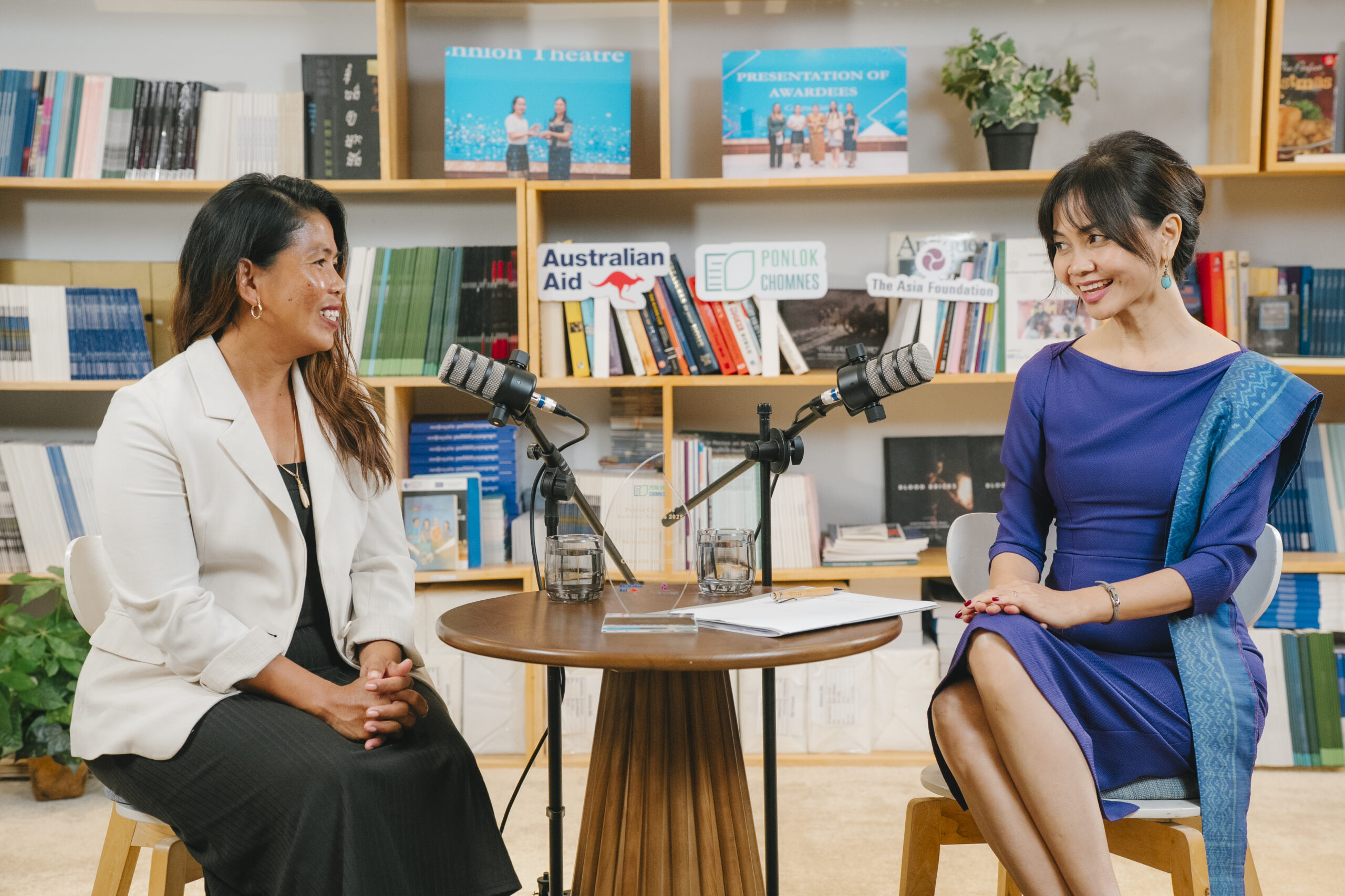
Ms. Nov Sreyleab (left) and Ms. Lim Solinn (right)
Below is a transcript of a conversation between Ms. Lim Solinn, Founder of Saddhā Strategy & Policy Consulting Enterprise, and Ms. Nov Sreyleab, founder of Lakhon Chhloh and winner of the 2025 Inclusive Dialogue Award.
- Solinn: Chumreap Sour (Hello) everyone, and welcome to the Podcast4Inclusion. I am Lim Solin. I would like to introduce you all to the winner of the Inclusive Awards 2025, Sreyleab. She is the creator of the Lakhon Chhloh programme from Siem Reap and is the 2025 award winner joining us and our audience here in this fifth podcast episode. Sreyleab, I know a lot about Lakhon Chhloh, and I was truly thrilled to learn that Lakhon Chhloh had won the 2025 award. Could you tell our audience a bit about yourself? Firstly, please introduce yourself so everyone knows who Sreyleab is, where you are from, and why you created Lakhon Chhloh in Siem Reap. Secondly, please tell our audience what makes Lakhon Chhloh so special.
- Sreyleab: Yes, thank you very much again. My name is Nov Sreyleab. I am an independent artist specialising in spoken theatre and the founder of Lakhon Chhloh, based in Siem Reap. Chhloh works directly with community members who are vulnerable groups facing violence and discrimination, and who rarely have the opportunity to participate in various social programmes. Chhloh works directly with them, using the art of theatre to reflect on their challenges.
- Solinn: So, how did you find out about the Inclusive Awards?
- Sreyleab: I found out about this through a staff member at the Women Peace Makers organisation. She shared the link with me on Telegram and said, “Sister! You should check out this link.” When I looked at it, I saw that… oh! It was quite interesting, so I applied.
- Solinn: And how did you feel when our team told you that you had won the first place award for the year 2025?
- Sreyleab: I felt very excited. I mean, I was truly surprised when they announced that I had won the award. This is actually the first award in my life. Receiving my first award like this, I was so thrilled because I thought Chhloh was just a small group that had just started, and perhaps not many people would be interested or know about it. But getting the result that I won- I was thrilled.
- Solinn: We were just as excited for you when we heard the results. And when you say Lakhon Chhloh is small and unknown- that’s not true at all! It may be small, but it’s impactful, and many people know it. I’ve been a social worker for 20 years, and that’s how I know about Lakhon Chhloh and understand its unique qualities. So, winning this award didn’t happen for no reason; it truly is special. Taking this opportunity, Sreyleab, as we invite you to this fifth podcast episode, could you please tell our listeners and viewers what makes Lakhon Chhloh unique? What techniques do you use when working with our community members, using this art form as a reflecting mirror to push for positive policy changes for our people?
- Sreyleab: Certainly. The unique feature of Lakhon Chhloh is that we work directly with community members. The theatrical performances are produced by the community members themselves, not by professional artists. These are community members who are currently suffering from issues such as violence and discrimination- groups that lack opportunities, like those who have been marginalised. So, we work directly with them, using theatre to build confidence and relationships, and to share their stories in front of relevant stakeholders such as authorities, organisations working on these issues, their partners, and their communities. So, it is performed by them personally.
- Solinn: So, firstly, you build their confidence and teach them about relevant social issues. When teaching them, do you bring in relevant local organisations to educate them? What are the main things they learn to understand, Sreyleab?
- Sreyleab: Yes. The programme has steps. First, we use theatre exercises and techniques to build their confidence in communicating with others and to give them the courage to speak about their challenges. Because some victims, when they have problems, they don’t speak up. Even if they are right, they don’t speak; if they are wrong, they don’t speak. So, we teach them to be brave in talking about their challenges and sharing their problems in front of the public, the audience, and the authorities. This is to make people think about their issues: What are their problems? Have they been resolved? And if not, where are they stuck? After the performance, there is a discussion involving the authorities, organisations, the community, and the performers who are the victims themselves. They discuss where the problem is stuck, where it can be resolved, and who needs to step in to solve it. Furthermore, we don’t just perform plays; we also have training sessions on topics such as law, gender, violence, public services, and access to public services. Then, we take the ten victims, who were always afraid before, on a study tour with the authorities. We arrange a time for the authorities to meet with this vulnerable group and discuss any questions or problems they have. When they have issues, our community members- the victims- will raise them, saying, “My problem is like this. I came once, it was like this; twice, it was like this. What is the problem? Why is it stuck there?” Then the authorities respond according to their procedures, laws, or customs. If we see that it’s not working at that point, we look for help on where to go next. For example, if documents are missing for filing a complaint, who can help them with that? The authorities then guide them to the relevant departments they have set up, so the community members understand immediately. So, after the programme ends, community members have the courage, knowledge, and connections to seek services themselves, even without me.
- Solinn: That’s excellent, Sreyleab. It shows that the process of organising Lakhon Chhloh involves everything from preparing the story, bringing the victims to perform their own stories for everyone to see—including the authorities—then organising study tours, discussions, and drawing participation from relevant local organisations to provide technical input in discussions to find solutions to the bottlenecks faced by the locals Lakhon Chhloh works with. This is very comprehensive! From start to finish, the scope is truly large. As a social worker myself for over 20 years, I understand, Sreyleab, and I know it is very difficult to do. Listening to you speak, it sounds easy, but it’s not easy at all; it’s very hard work. So, my question is, another point I’d like you to explain to our audience is: why did you choose performing arts? Because when we want positive change and for services to truly reach our people, there are many methods; we could just go meet the authorities directly. But you decided to use Lakhon Chhloh, theatre, performing arts on stage. Why? Because theatre arts are an accessible method that allows the audience or participants to understand easily- to understand everything, really. It creates an accessible environment for participants- whether they are children, the elderly, literate, or illiterate- to receive the experience and the educational content simply by watching the play. Because when we perform, it makes them feel happy, feel sad along with the story… experiencing that joy and all those emotions makes them remember it vividly. It has comic scenes, tragic scenes, describing all sorts of things, making the listener feel relaxed and able to understand easily. The scenes are funny, sometimes sad, containing a mix of everything, which makes the viewer immerse themselves in the characters. So, they remember it, right? Do people get immersed when they are watching the play like that?
- Sreyleab: Yes, sister. There are scenes where, when we are sad, they cry. The audience cries along with us, with the characters. And during the funny scenes, they laugh along; they find it hilarious. Especially since the play includes comic scenes. From my past experience, I remember acting in a play related to HIV/AIDS. There were two characters. One was HIV/AIDS, wearing clothes and a black hat with spikes to represent the virus. And the other one was wearing a condom costume—they made a huge condom and the actor fit inside it. When the audience saw it, they were surprised and shouted, “Wow, what a huge condom! It’s so big!” It was very funny. They remembered the condom. Then came the scene where HIV fought the Condom, and HIV lost. So, they remembered, “Oh, the condom is strong; it can beat HIV.” They talked about it and memorised it. So, I think it’s a great memory aid, easy to understand, and funny. It’s a good method to let people learn while having fun and remembering the message, all while keeping our arts alive within it.
- Solinn: Yes, this is the unique feature of Lakhon Chhloh, using discussion, performance, and dialogue with relevant authorities. Sreyleab, you explained the stages and methods that Chhloh theatre has used with our target groups. It sounds very easy, but as a social worker for over 20 years, I know it isn’t easy; it’s very difficult work. So, to let our podcast audience understand how difficult your work is and what the specific nuances are, could you give us an example? A concrete example of a project Lakhon Chhloh conducted directly with a specific vulnerable group at the local level, so our audience can understand?
- Sreyleab: Yes, sister. Back in October 2025, I just finished a project with the community. The project ended, but the community members are still working together. At that time, I produced a play titled “Lack of Light.” This story was based on true stories extracted from the lives of my 10 community members who shared them. After they shared their stories, I wrote the play “Lack of Light” and performed it in their community, in front of the community, authorities, and relevant organisations. The aim was to share their challenges. Their stories had been happening for a long time, but no one cared, no one raised them, and no one listened. So, I used theatre to produce this story, speaking about their unresolved challenges, performed right in front of those whose role it is to solve them. When we performed it, it made the audience feel and see the story, acknowledging that it was true, that it really happens in the community. And it didn’t just happen to that one female character; it happens to everyone. The audience watched and said, “Oh, that’s my story! That’s my story!” Everyone watching felt it was their own story. So, these problems truly exist in our Cambodian society; they happen, and the solutions fail repeatedly. When we played the scene where the problem couldn’t be solved, we asked: Who has the capacity to solve this? At that moment, the audience was made to think. They saw where the problem was stuck—because of this and that, point one, point two, point three. So, they started giving feedback. And the feedback didn’t just come from the audience, but also from the authorities and partner organisations working on solving those issues. So, that forum allowed the audience, authorities, partner organisations, and my 10 victims to learn. They learned to understand that the problem happens like this, and this solution makes it work. If it’s stuck in real life, it’s stuck like this, and everyone seeing it must join together to solve it. After the performance ended, we connected them- the organisations, authorities, and my vulnerable group members. They made appointments, exchanged contact numbers, called for consultation, and met up. Yes. So, this project not only empowered my community members- who lacked opportunities, were discriminated against, or had lost their courage- to have relationships with the authorities and supportive partner organisations, but also with other community members. And it wasn’t just the 10 community members I worked with; the villagers who watched the performance started to recognise them. Before, when they walked by, no one called out to them. But now, when they walk, people call them, ask them questions, and recognise them. So, it’s something that makes the vulnerable community members- who were previously unheard, unknown, and ignored- suddenly visible and interesting to others.
- Solinn: And what about you, Sreyleab, as the facilitator for the people, the local residents facing problems- some of whom are illiterate, some are depressed, and some don’t even want to meet the local authorities- facilitating their meeting with organisations that provide technical skills and consultation, and bringing them to meet local authorities? For you, Sreyleab, as the facilitator of that experience, how did you feel?
- Sreyleab: I felt that the experience was quite tense for me at first because they didn’t know me. They didn’t know who Sreyleab was or what Chhloh was. But regardless of the issues, initially, they didn’t really accept us much. It was quite tough to find that support. But once I showed them our work, they said okay, it’s good, and they allowed me to do it. I think once I did it, I was happy. Because I think what I wanted was for my community- no matter who, whether uneducated people or women facing problems- to know that problems shouldn’t just stay stuck there. Problems must be raised, and solutions sought. So, I am happy to have worked with my community and to have enabled those facing challenges to walk step-by-step through the process of finding solutions. So, I am happy.
- Solinn: And now, even people have come to know Sreyleab, know Lakhon Chhloh, and understand the special characteristics of Lakhon Chhloh. It helps drive solutions to the challenges our people face, especially vulnerable groups such as persons with disabilities, women, and girls facing gender-based discrimination, indigenous peoples, as well as other vulnerable people who are mostly marginalised in society, enabling them to participate in policy discussions regarding the public services relevant to them. And now, through this podcast, even more people will know Sreyleab and Lakhon Chhloh and its unique features. Sreyleab, when you raised the scope of the techniques used with Lakhon Chhloh, we saw that it is very broad. It connects everything: firstly, how to make the local population understand the problems they face, and then connecting that to the local authorities, allowing them to meet and understand the real difficulties. You demonstrated this with a few examples, which was excellent. I would like to ask Sreyleab one final question. Through all your experience working with Lakhon Chhloh for many years, acting as a facilitator between vulnerable groups at the local level- most of whom have no experience or are even illiterate- connecting them and their problems to the local authorities, and pushing for positive solutions for them in return, drawing on all this extensive experience, could you summarise for our viewers watching this podcast? Could you help them see and understand how important the role of art is in acting as a reflecting mirror to participate in driving development and positive policy change that are beneficial and appropriate to the living conditions of our people at the local level?
- Sreyleab: I think art is strictly important, Sister, in connecting or solving social problems. Practically, as we have done in the past, we use art to reflect the challenges the community encounters- whether it is trafficking, unsafe migration, violence, and so much more. We produce these performances to reflect social issues. So, when we reflect on the problems in each performance, it shows what the problem is and where the issue lies. When we demonstrate this in the presence of those involved in solving it or in policy formulation, they start to see, they start to discuss, and they start to amend things immediately. Yes, so it connects and works together very well. Art and policy formulation fit together very well, Sister; it’s like that. When we reflect it back, and the policymakers see the problem, they revise the policy and re-introduce it so that it aligns with the actual situation. So, I see that it is good; it helps a lot.
- Solinn: Yes, thank you, Sreyleab, for explaining so thoroughly to our viewers watching this podcast. Everyone, you have now watched this podcast and met directly with Sreyleab, the creator of the Lakhon Chhloh programme from Siem Reap. And Lakhon Chhloh, as you have heard from Sreyleab’s detailed explanation, is a performing arts tool used to reflect the problems that our Cambodian people face, especially vulnerable groups such as persons with disabilities, children and women facing violence, indigenous peoples, as well as the LGBTQ+ community and other segments of our population who are vulnerable. This is a strategy Lakhon Chhloh uses to promote inclusive discussion. And “inclusiveness” here means “promoting participation from all local bases, especially vulnerable people from all groups.” So, the Lakhon Chhloh programme is very special; it not only shows everyone the unique method of using theatre to reflect real social conditions, but it also connects people to push for positive solutions from local authorities. So, art, as Sreyleab mentioned, plays a vital role in reflecting, connecting, and driving policy change in our Cambodia in an inclusive manner. I, Lim Solinn, would like to thank all the audience members who participated in watching this fifth podcast, which showcases the 2025 Inclusive Discussion Award, where you all met directly with Ms. Nov Sreyleab, the creator of Lakhon Chhloh from Siem Reap. I would like to encourage and invite you all to visit Lakhon Chhloh’s Facebook page. In Khmer, write “ល្ខោនឆ្លុះ”, and in English, write “Chhloh Theater.” Go and have a look to understand how their strategy works. I encourage everyone and all stakeholders to cooperate and work with the Lakhon Chhloh troupe from Siem Reap to promote inclusiveness in our Cambodian society. I, Lim Solinn, and Sreyleab thank you. Goodbye.
If you would like to watch this podcast, please click here.
END.